

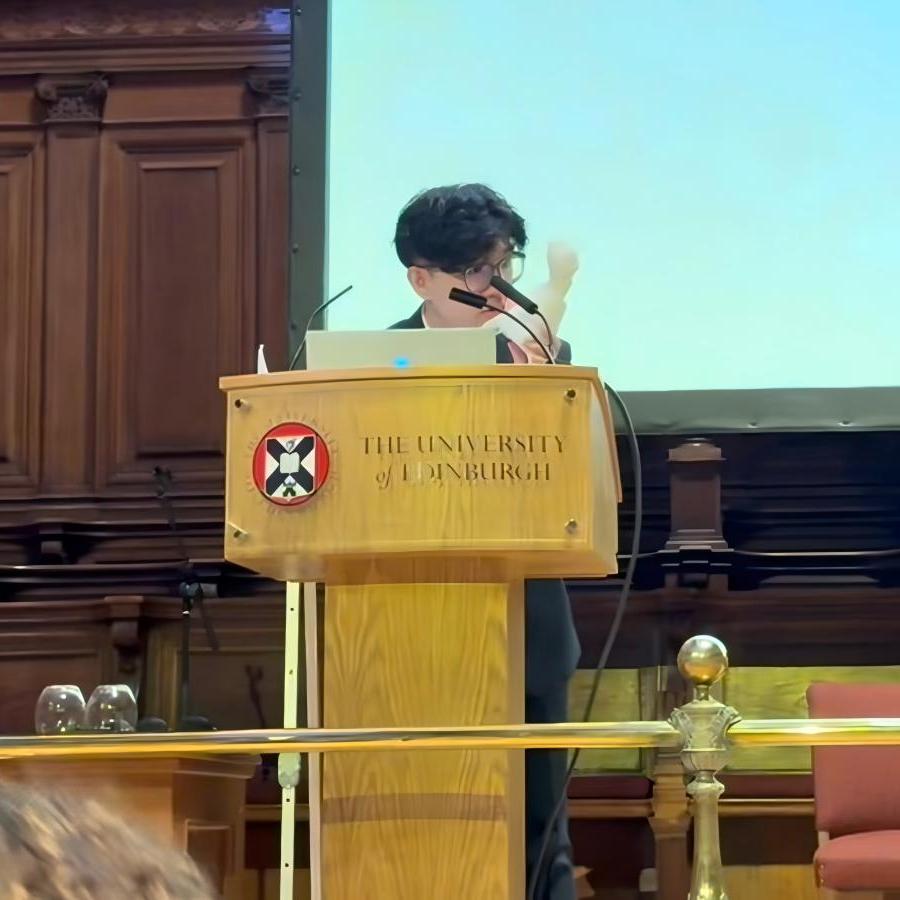
Zhiyang Ding
Programme:
Design - MPhil/PhD
Start date:
September 2024
Mode of study:
Full time
Research title:
Mechanical Jewellery as Speculative Companion Species: Playful and Embodied Human–Machine Relations
Research Output:
Edinburgh Research Explorer linkBiography
Zhiyang Ding is a jewellery artist and design researcher, currently a PhD candidate in Design at the University of Edinburgh. He graduated from the Royal College of Art with an MA in Jewellery and Metal in 2023. His practice-based research explores mechanical jewellery as speculative companions at the intersection of wearable objects, performance, and embodied interaction.
His PhD project reimagines jewellery as speculative companion species rather than passive ornament. Working through a Research through Design (RtD) approach, he develops iterative wearable prototypes as a means of enquiry, using making, testing, and reflection to investigate emerging relationships between bodies, objects, and machines. Integrating low-tech mechanics, principles of Artificial Life, and unpredictable movement, his works function as semi-autonomous agents that explore intimacy, agency, and human–machine sympoiesis, drawing on Donna Haraway’s concepts of Companion Species and Making Kin.
In practice, his research develops and tests mechanical jewellery through a range of participatory workshop formats with different communities and disciplinary contexts, including design and jewellery students, public participants, and performers. Through iterative prototyping, embodied interaction, collaborative making, observation, and reflection, he examines how playful and sometimes absurd encounters with wearable machines can generate new understandings of embodiment, coexistence, and more-than-human relations within entangled technological futures.
Research interests
- Embodied Interaction
- Tangible Interaction
- Mechanical Jewellery and Wearable Objects
- Speculative Design
- Participatory Workshop Methods
- Research through Design (RtD)
- More-than-Human Design
- Human–Machine Interaction
Zhiyang Ding’s research explores mechanical jewellery as a form of speculative, embodied and more-than-human design. His work investigates how wearable objects can move beyond passive ornament to become active participants in interaction, shaping relationships between bodies, materials and machines.
Using a Research through Design (RtD) approach, he develops low-tech mechanical and interactive jewellery through iterative prototyping, embodied testing and participatory workshops. His research draws on embodied interaction, tangible interaction, Artificial Life, speculative design and more-than-human perspectives to examine how movement, touch, unpredictability and play can generate alternative forms of human–machine engagement. He is particularly interested in jewellery as a companion-like interface: something that can be worn, touched, interpreted and negotiated through the body.
A further strand of his research focuses on participatory workshop methods. He uses different workshop contexts to explore how participants engage with mechanical jewellery through making, movement, discussion and sensory interaction, and how these encounters can inform both design practice and research knowledge.
Two recent publications illustrate these interests. Mechanical Jewellery as Playful Design: Entangling Human and Machine examines mechanical jewellery through playful, performative and embodied interaction, with attention to Artificial Life and behavioural response. Mechanical Jewellery as Epimethean Practice: Staying with the Trouble of Human–Machine Entanglement, presented at DRS2026, explores speculative human–machine relations through Epimethean practice and considers how mechanical jewellery can support critical reflection on technological coexistence.