Dr Mark Hilley

Job title:
Teaching Fellow in Architectural Design and Theory
Office:
Minto House
Biography
Mark is a Teaching Fellow in Architectural Design and Theory. A registered architect (ARB) and research-by-design scholar, from 2023-25 he also served as academic Co-Lead of the Making, Method and Multispecies cluster at the Scottish Graduate School for Arts and Humanities EARTH Scholarships, an international doctoral and postdoctoral training programme funded by British Council Scotland. His research by design, which focuses on the ecological & ecosophic consequences of building in a time of crisis, has been presented at conferences, published in peer-reviewed journals and developed in forthcoming co-authored interdisciplinary book chapters. His work looks at ecological approaches to architecture and urban design, exploring post-industrial and post-colonial landscapes and cities that test the limits of human understanding of time and scale in relation to human perception and more-than-human worlds and environments.
In conjunction with this academic focus Mark has held several senior positions in architectural practice in Scotland and London. He graduated with a BA (Hons) Interior Design in 1999 from ECA, a B.Arch in 2004 from London Metropolitan University and an M.Arch in 2006 from the University of Edinburgh, before completing his PhD (Architecture by Design) at ESALA/University of Edinburgh in 2020. Mark also holds a PGCert in Learning and Teaching in the Creative Disciplines from Glasgow School of Art, with Advance HE Fellowship (FHEA) in preparation.
Research interests
- Ecology and ecosophy in architecture and urbanism; more-than-human worlds
- Research by design; drawing ecologies | ecologies of drawing
- Building in a time of crisis: post-industrial reuse, deep time, scale
- Survey as calibration: situated field methods, archive, ‘open work’
- Citylandscapes and Extraction: colonial and cartographic afterlives
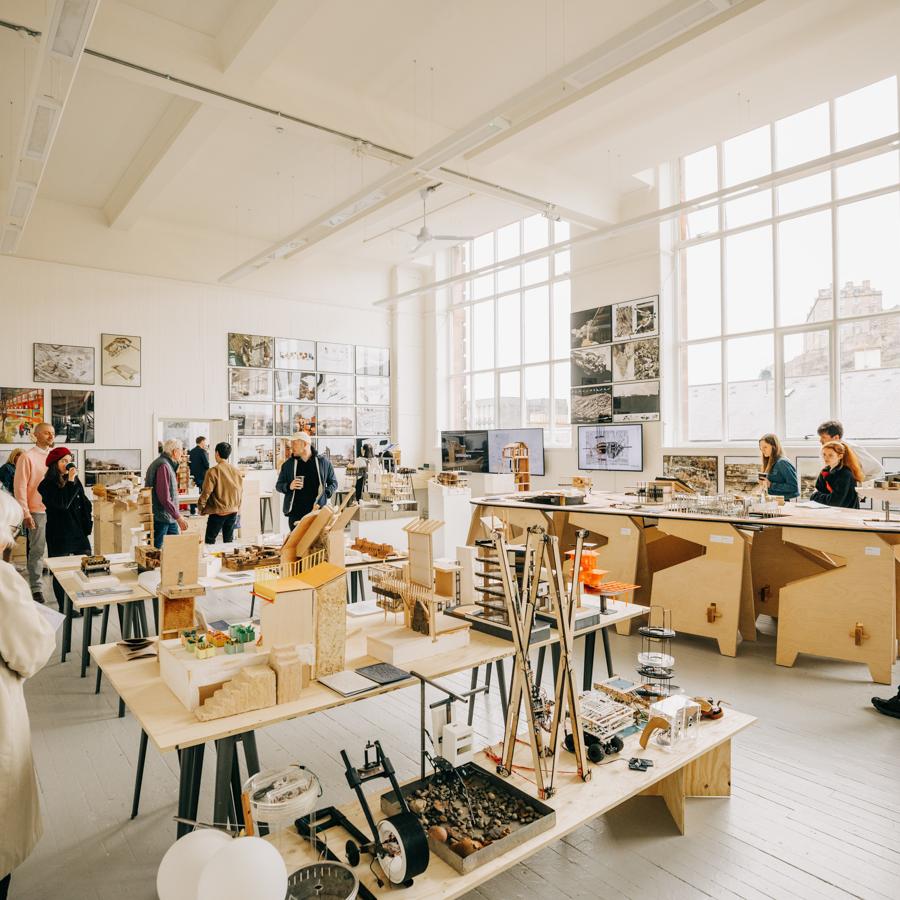
Drawing upon his research by design and professional experience, Mark teaches across ESALA's undergraduate and postgraduate programmes. He has a particular interest in architectural theory held in dialogue with architectural design, landscape and contemporary urban conditions, and in the situated, design-led research methods through which critical inquiry proceeds. He currently works on the MSc Architectural and Urban Design (AUD) programme, where he teaches and supervises across three design studios and leads two theory courses, Research Skills and Methods (RSM) and Readings in Contemporary Architectural Theory (RCAT) as Course Organiser/author.
Over the years Mark has been involved with the following ESALA design programmes, courses and studios:
MSc Architectural and Urban Design - design studios
- PARA-situation [Edinburgh]: The Space of Appearing (2021–22)
- PARA-situation: Thin Places, Daire/Doire/Derry/Londonderry (2022-24)
- PARA-situation [Daire]: A "Possible" on Edgy Sites (2024–25)
- PARA-situation [Wild Edinburgh]: The FAB -(n/k) G (2025–26)
- Metabolisms [Grafting cosmograms: cultivating images and imaginaries for Edinburgh] (2026–27)
MArch:
- Studies in Contemporary Architectural Theory (SCAT) - devised and delivered the option drawing ecologies | ecologies of drawing: making marks, peeling pavements and throwing paint (2022–25)
- Derry Studio -visiting critic (2022–24)
- Shared Islands Studio - visiting critic (2025-26)
BA/MA (Hons):
- Architectural Theory - tutorial cohort lead
- Architectural Design - years 2-4
Research
Research
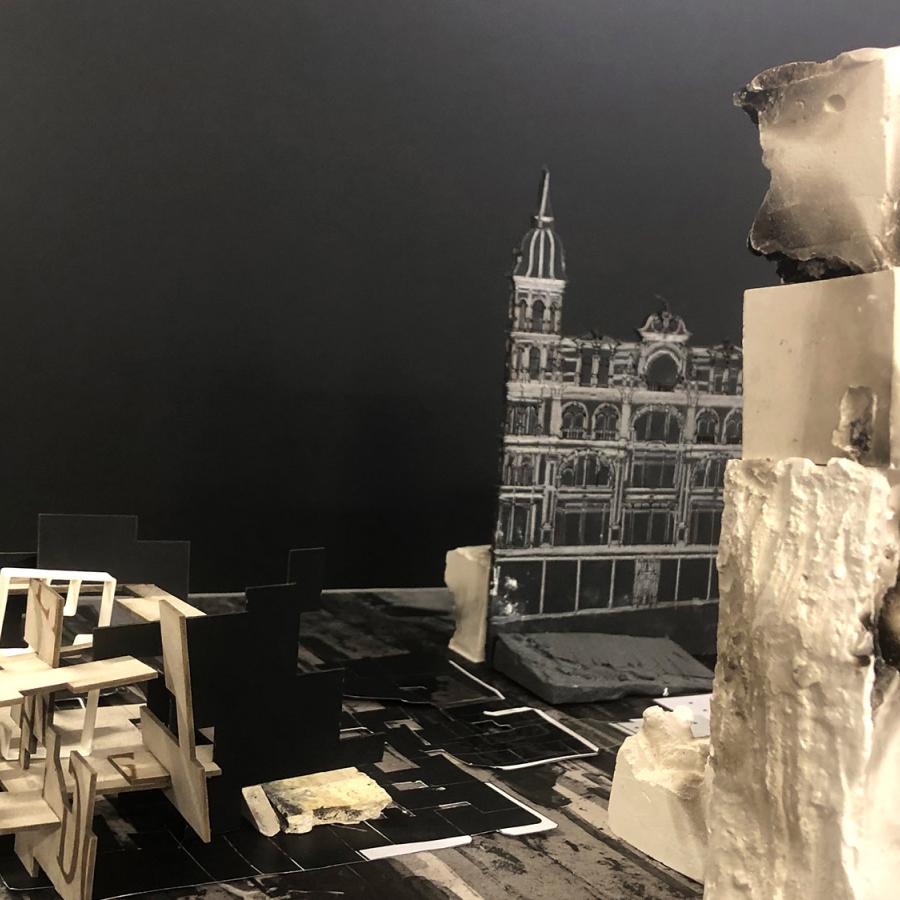
Mark's research by design examines the ecological and ecosophic consequences of building in a time of multiple crises. Working across key entangled frames of design, making and theoretical writing, he questions the present systemic reliance on 'known' patterns or accepted ways of being. By interrogating specific abandoned post-industrial sites as local moments of incubation and of resistance to global processes, his work unpacks the material, methodological and representational conventions of architecture and urban design. In doing so, it traces and reveals their embeddedness within global agrilogistic networks and the consequences of accepting the corporatocratic appropriation of the shared biosphere.
His doctoral thesis, Artificial Grounds (2020), examined the post-extractive urbanism of Scotland's former shale oil industry, reading the oil shale 'bings' (spoil heaps) of West Lothian as sites of ecological recovery and resistance. It drew on Timothy Morton's The Ecological Thought and their account of global warming as a 'hyperobject', together with Félix Guattari's 'Integrated World Capitalism', Michel Serres's temps (at once time and weather) and Donna Haraway's multispecies 'becoming-with'. Through this framework, it situated the dispersed urbanism of the Central Belt within wider cycles of extraction and displacement of people from the land, revealing the potential for deeper more-than-human coexistence. Two ongoing series, Disruptive Ecologies and Anamorphic Entanglements, extend this research through drawing, which they treat as a mode of ecological attention and attunement.
A second strand develops writing, recording through survey, and drawing, as research methods in their own right. Following Umberto Eco's notion of the 'open work' and the practice of the artist David Ireland, Mark approaches architectural drawing as a temporally layered activity that registers climatic rhythm, maintenance, decay and the traces of human and non-human occupation. This approach informs a continuing interest in the city-landscape after Patrick Geddes, the Stadtlandschaft after Florian Beigel and Philip Christou, and the archive and its absences after Carolyn Steedman and Jacques Derrida. The same interest extends to colonial legacies, read through domestic and cartographic space.
Mark disseminates this work through research-led teaching, peer-reviewed publication and collaboration across disciplines and institutions. Recent outputs include 'Ecological Entanglements: Architectural Legacies of the Shale Oil Industry' in Testing Ground, Issue 04: Supra Scalar (University of Greenwich, 2023). A chapter co-authored with Dorian Wiszniewski is forthcoming in Wild Scotland? (Aberdeen University Press), a volume developed through the Interdisciplinary Rewilding Research Network. From 2022 to 2025, Mark was Academic Co-Lead of the Making, Method and Multispecies cluster within the EARTH Scholarships of the Scottish Graduate School for Arts & Humanities (SGSAH). In this role, he co-designed, hosted and delivered interdisciplinary training across Scottish higher education institutions in conjunction with a Co-Lead from Edinburgh Napier University. He also serves as an advisory panel reviewer for Edinburgh Architecture Research (EAR) and contributes to public engagement events.
PhD Supervision Topics
- Ecology and ecosophy in architecture and urbanism
- Drawing and survey as modes of ecological inquiry -drawing ecologies | ecologies of drawing
- Building in a time of crisis: the reuse of post-industrial ground, climate and biodiversity
- Deep time, scale and the supra-scalar; more-than-human and multispecies worlds
- City-landscapes and extraction, and their colonial and capitalist afterlives
- The archive, absence and the 'open work'