
Anna Rhodes

Job title:
Lecturer in Landscape Architecture
Office hours:
Mon - Fri, 9am - 5pm
Research Output:
Edinburgh Research Explorer linkBiography
Anna is a Lecturer in Landscape Architecture and a practising Landscape Architect. She received her BA (Hons) in Painting and Printmaking from The Glasgow School of Art in 2011 and her Master’s in Landscape Architecture from Edinburgh College of Art in 2014. In 2018, she became a chartered member of the Landscape Institute. Before joining academia, Anna worked in professional practice in Glasgow and Edinburgh with Gillespies, HarrisonStevens, and Here+Now. She established her own landscape architecture practice in 2017.
Anna's interests, practice-based research, and approach to teaching are situated at the intersection of landscape architectural and artistic practice. Her art and landscape architectural works have been installed, exhibited, and presented across the UK and internationally.
Research interests
- Multiscopic fieldwork
- Landscape representations
- Gardens as activators for change
- Multispecies studies
- Scottish island landscapes
- Exhibiting Landscape Architecture
Anna considers writing design studio briefs a significant strand of her research methodology. This process structures and deepens her research interests and design priorities within a pedagogical context. The studio’s insights, divergent perspectives, and constructive exchanges enrich the contextual frameworks she engages with, advancing and refining her research.
Since 2020, Anna has been the course organiser for the final-year Landscape Architecture research-by-design courses. The briefs she authors provide a theoretically informed, spatial and conceptual framework to foster diverse projects that explore various contemporary landscape architectural concerns. Anna creates a studio environment that encourages students to operate critically and experimentally and to practice design as a form of enquiry, activism, and agency.
2020-22 ‘Dear Green Glasgow’
Exploring show gardens as catalysts for future landscape-led city visions, this studio invited the re-contextualisation of the 1988 Glasgow Garden Festival, situated amidst contested policies and discussions surrounding the UN Climate Change Conference (COP26).
2022-24 ‘Critical Zones: The Highland Boundary Fault’
Traversing the fault zone, multi-scopic fieldwork and interdimensional representations took into account social, ecological, and geological fractures, as well as points of tension and upheaval, enabling students to define their own zones in need of critical attention, design action, and care.
2025-ongoing ‘Paradise Spectacle Fabric’
The studio shifts between paradise; the garden as cultural ideal and ecological construct; spectacle, the show garden as a public format for staging ideas; and fabric where speculative, landscape-led design propositions address the particular complexities of Scotland’s contemporary urban conditions.
Anna supervises design responses to relationally aware social and environmental challenges and supports students in preparing for professional practice as critical thinkers and ethically engaged practitioners. Projects she has supervised have won prestigious awards, including the European Council of Landscape Architecture Outstanding Masters Student Award in 2021 and 2024, and the Rosa Barba International Landscape Architecture School Prize in 2018.
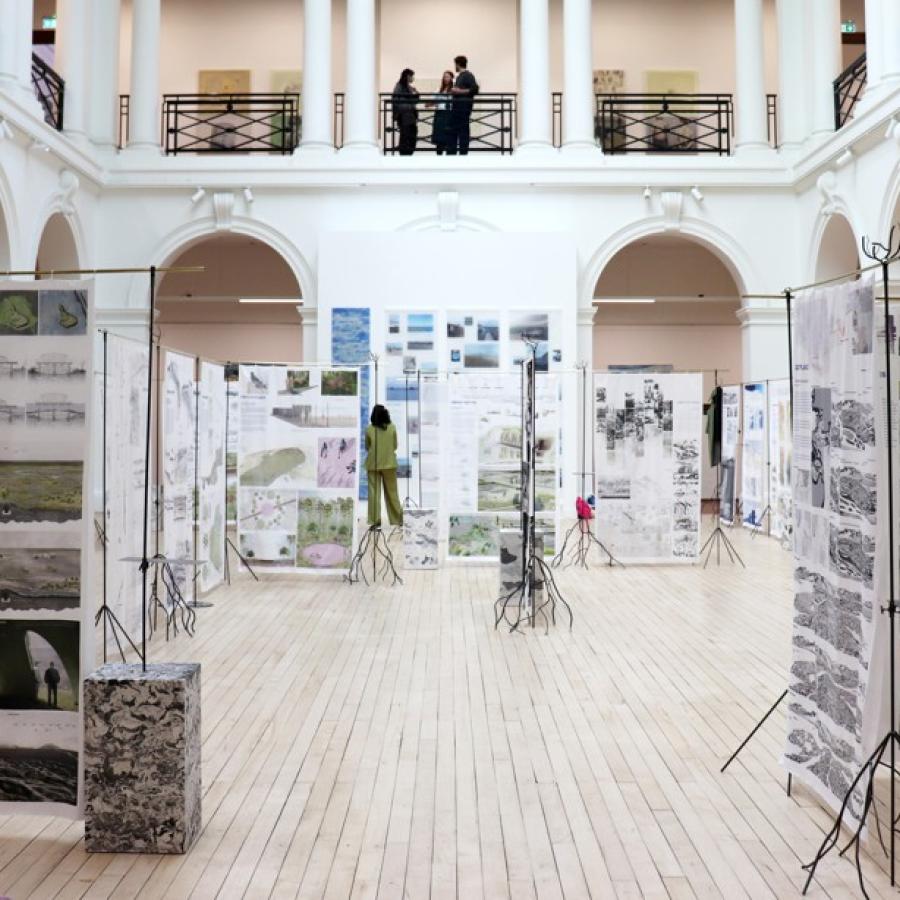
Anna promotes exhibitions as a means to share and provoke critical reflections on landscapes with other landscape architects, allied professionals and societies. She coordinated the ECA graduation shows for architecture and landscape architecture (2021-23) and has been curating the ECA landscape architecture graduation show since 2021.
Anna is accepting PhD students. She is interested in the supervision of PhD research conducted by practice and in interdisciplinary supervision.
Research
Research
Anna's research practice is rooted in her creative interpretations of landscapes, where she feels the weight of the unseen, uncovers layered stories, and sometimes imagines otherwise. Her research interests are interrelated and propelled by fieldwork, landscape architectural design practice, and drawing. These interests can be broadly categorised by three key priorities:
Gardens as activators for change. Exploring how gardens can operate as critical tools for challenging conventions, staging debates, and foregrounding alternative perspectives Anna investigates the potential of gardens to creatively disseminate ideas, raise questions, imagine futures, and encourage community care.
Through her research of the garden as a cultural ideal and ecological construct and through her direct experiences in realising public sculpture, community gardens and show gardens (Tête à Tête Chaumont-sur-Loire International Garden Festival 2017, Arrange: Rearrange RHS Tatton 2017, Carmine Catcher Radicepura Garden Festival 2019).
Landscape representations that explore and communicate complexity. Anna's work navigates complexity and uncertainty to create ecologically explicit landscape architecture, a concept inspired by Timothy Morton's work on eco-aesthetics, and adapted here to foreground and support more-than-human worlds in the context of landscape interpretations and design. Drawing on relational dynamics, she develops graphic representations informed by multi-scopic field recordings, which highlight the intricate processes, rhythms, and interactions of more-than-human landscapes. A notable example is the WW1 peace garden in Arras, France, which she designed and installed with collaborator Melissa Orr in 2018: Anna has been revisiting this garden to trace its evolving ecology, local stewardship, and seasonal character, and is developing representations that foreground complexity, transience, and care.
Curating exhibitions of landscape narratives and ideas. Anna explores innovative methods for deepening and showcasing landscape interpretations and designs through the curation of exhibitions and participation in residencies or field workshops that facilitate knowledge-sharing and collaboration with artists, researchers, and arts organisations.