

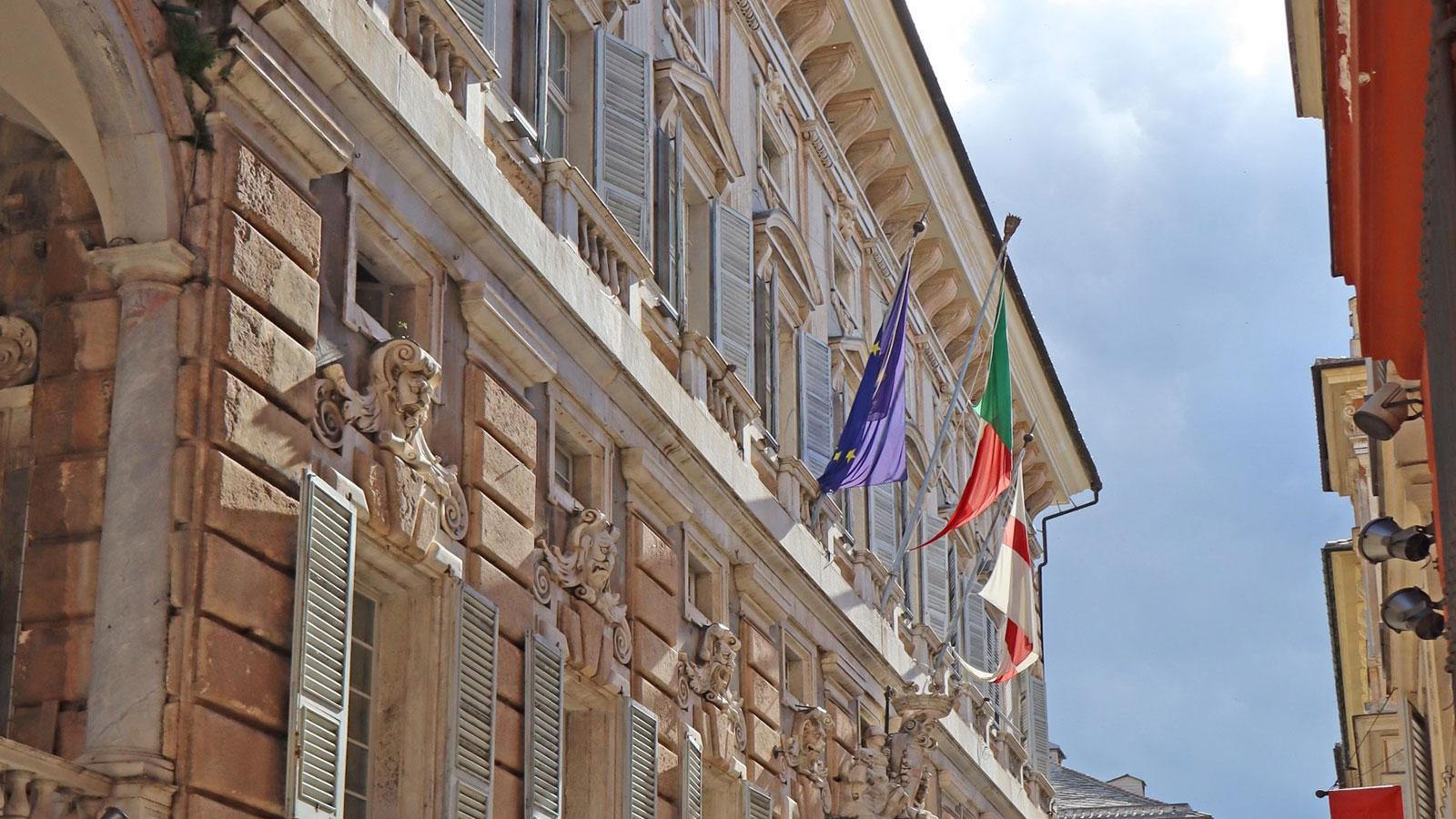
Strada Nuova, Genoa (photo: Rebecca Gill)
This lecture will be hybrid. Please book your ticket for attendance in person or online. You will receive access to the online event via email the day before the event.
Abstract
Galeazzo Alessi (1512-1572) had an extraordinary impact on the architecture of sixteenth-century Genoa, not only because his buildings were so influential, but because his construction sites were the cradle for many Genoese architects and masons who followed in his wake. This paper focuses on two of these building sites: the church of Santa Maria Assunta di Carignano and the Strada Nuova, and explores the working relationship between Alessi and his capi d’opera. Questions will be raised regarding who was responsible for what at these sites and how these builders rose to independence to take on their own projects in the city. While the Carignano church is securely attributed to Alessi, the authorship of the palaces on the Strada Nuova is a continued topic of debate. However, the careful examination of drawings for the palaces of the Strada Nuova, collected by P. P. Rubens and published as the Palazzi di Genova in 1622, held today in the RIBA collection, enables us to reconsider the question of who was responsible for the design of the palaces along the Strada Nuova. Was it Alessi or his followers?
About Rebecca Gill
Rebecca Gill is Lecturer in Architectural History, ESALA, University of Edinburgh. She was previously research fellow at the Ax:son Johnson Centre for the Study of Classical Architecture at the University of Cambridge. Her new book, Sacred Architecture in the Age of Reform: Galeazzo Alessi and his Contemporaries, is forthcoming with Cambridge University Press – the first book to be published on Alessi in English. She was also the curator behind the National Gallery of London’s exhibition, Virtual Veronese, which used virtual reality technology to reunite an altarpiece by Paolo Veronese with its original architectural environment.
Event details