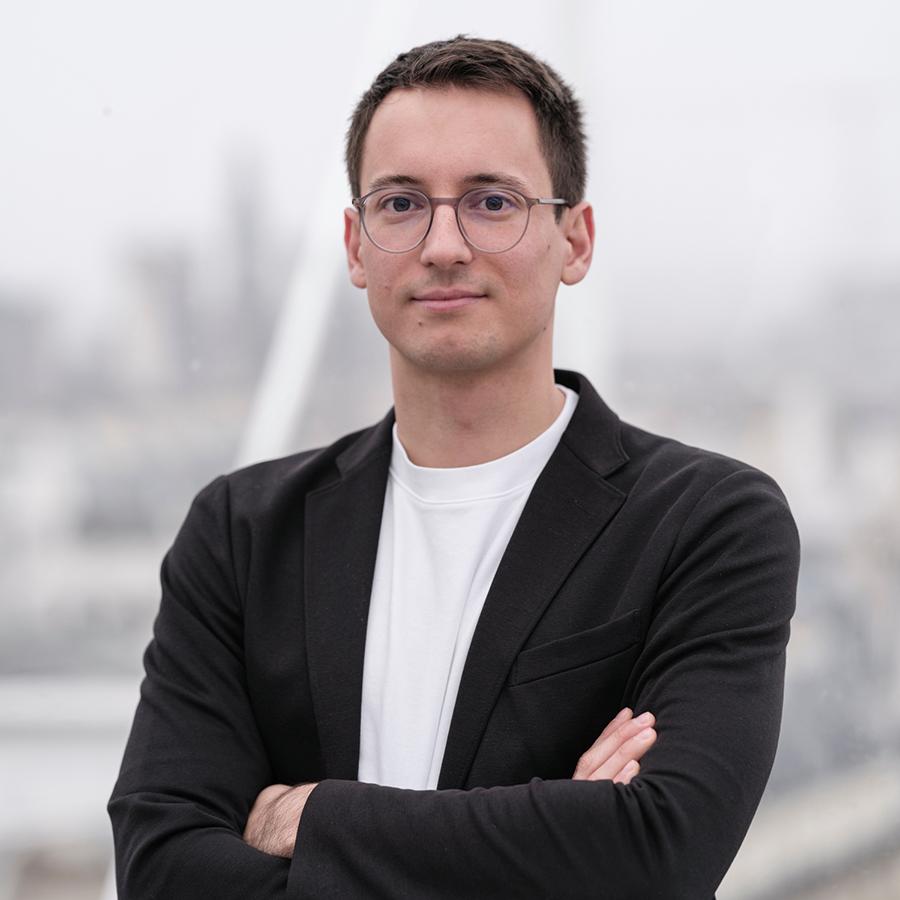
Matthias Pfaller stands outside, wearing a black blazer and white tshirt. He folds his arms across his chest and looks to the camera. Image Andreas Langfeld
While studying at ECA, Matthias enjoyed the visits to museums and heritage sites, as well as collaborations with fellow students in different programmes. He also had the opportunity to publish his work in the journal Art in Translation as well as present his research at a large conference in the USA.  
 
After graduating, Matthias went on to gain experience at world leading museums such as the MoMA in New York before completing his PhD on the history of photography in Chile. He now works as Assistant Curator of Photographs at the Centre Pompidou in Paris.

Why ECA?

While my flexible bachelor’s degree program in Germany allowed me to study many different subjects, I found that art history combines all my interests. Whether you’re interested in history, different cultures, politics, or environmental issues, you will find a field of research, and the best is: you can always discover and develop projects on new topics. For my masters degree, I chose Edinburgh College of Art specifically for its courses on contemporary art, which I did not want to study cursorily but in depth.

Since my sister had studied in Edinburgh and I visited the city, I could see myself there, too. The high reputation of the university was another factor. I knew that I wanted to work internationally and a diversified education was key for this, including a diverse student body. 

“What was probably most eye-opening at ECA was the fact that many teachers also work as curators, writers, and critics. Before, I thought I could only ever work at university, but a whole new world opened up for me, especially in curating.”

Matthias Pfaller

Tell us about your time at ECA

Coming to Edinburgh was an explosion of impressions and new things to discover. Edinburgh is so international that I found friends from England, Austria, France, Greece, Turkey, China, and notably, Chile. On top came my studies. As I was used to a different academic context, it was a challenge to adapt to the fast-paced one-year programme. Already while studying a totally new topic, you are writing your term paper – and the teachers’ demands on originality and academic rigour are high. However, this is what motivated me most: you’re not just rehashing some dated scholarship, but you are encouraged to actively take part in developing the field. I was lucky to be able to present some of my research at a big US conference after graduation, which confirmed my impression that studying history of art at ECA prepares you for the time after uni. This, of course, along with the ongoing support of my teachers, whom I cannot thank enough for giving me precious career advice and countless recommendation letters, and most importantly, for being genuinely interested in what I have been doing.

While I did not take the internship option and studied another history course, I immensely profited from visits to museums and heritage sites, as well as meetings with gallerists, curators, and artists, all organised by my teachers. I also had the opportunity to get in touch with the journal Art in Translation, in which I could publish a couple of texts. At the end of the year there was a collaboration between art history and fine art students, which brought the ECA community together. In retrospect, I should have met with many more art students, as I have become to really cherish this as part of my career.

On the side I also dabbled in writing blogs and trying to set up a mail art program with a fellow student. Not much came out of this in the end, but I am glad to have tried out many things to find those that really work for me, and the atmosphere at ECA provided the energy for it.

“Coming to Edinburgh was an explosion of impressions and new things to discover. Edinburgh is so international that I found friends from England, Austria, France, Greece, Turkey, China, and notably, Chile.”

Matthias Pfaller

Tell us about your experiences since graduating

What was probably most eye-opening at ECA was the fact that many teachers also work as curators, writers, and critics. Before, I thought I could only ever work at university, but a whole new world opened up for me, especially in curating. After graduating, I did several internships at museums, such as the MoMA in New York, the J. Paul Getty Museum in Los Angeles, and ZKM in Karlsruhe. At the same time, I did not want to give up my academic practice, and I worked on several journal articles (possible through the alumni access to JSTOR). Without the solid education on coming up with an original research topic and writing papers, and especially the ambition to publish in international high impact journals coming from my research at ECA, I would have been less successful in this endeavour.

After some more adventures, such as an almost two-year stint at an art insurance in Switzerland, I pursued a PhD in Germany. My topic was the history of photography in Chile – unthinkable had I not lived with wonderful Chilean flatmates in Edinburgh who awakened my interest for South America. In the process, I specialised in art from Latin America, which gave rise to more opportunities in Europe. As of 2024, I am Assistant Curator of Photographs at the Centre Pompidou in Paris. Ten years have passed, but what I learned at ECA is still with me today.

Alumni wisdom

Try to get to know as many people, places, and activities. The ease with which you can dive into new topics and get to know people in Edinburgh will rarely reoccur. And stay in touch! Especially in a small field such as art history, you will likely run into the same people for decades. Also, prepare yourself to leave Edinburgh, because although everybody wants to stay, your career will likely take you elsewhere. And be aware that deadlines for funding for PhD programmes etc. are very early and the application procedures are super specific. Ask your teachers for advice, otherwise you waste a lot of time and nerves.