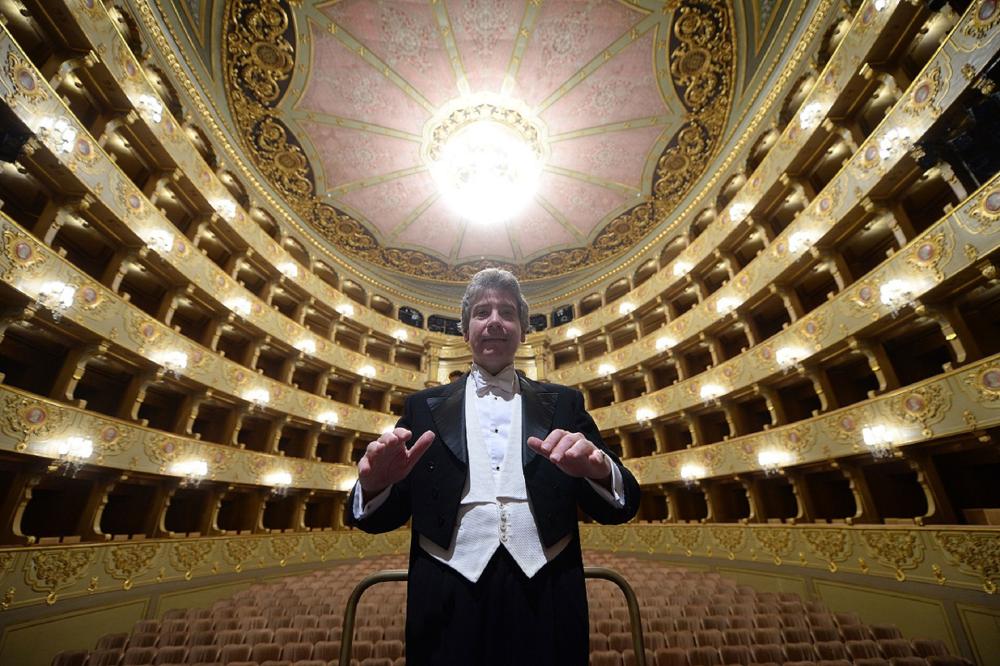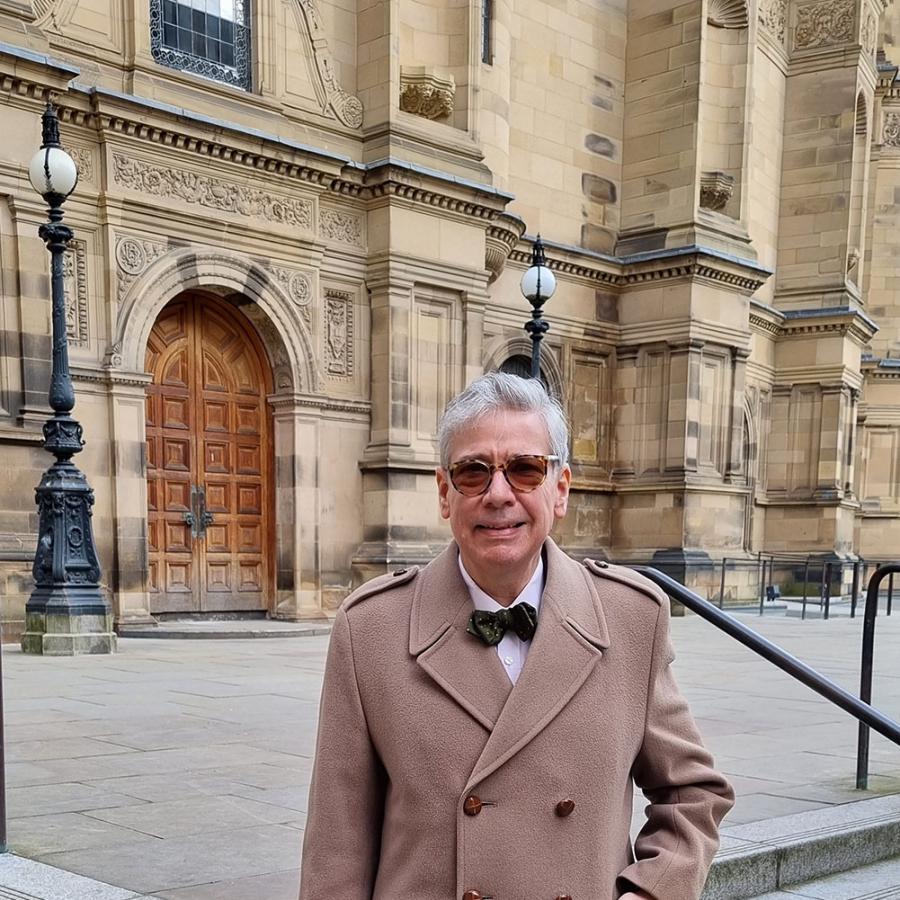
Emre Araci stands outside the McEwan Hall. He wears sunglasses, a smart camel coat and a bow tie.
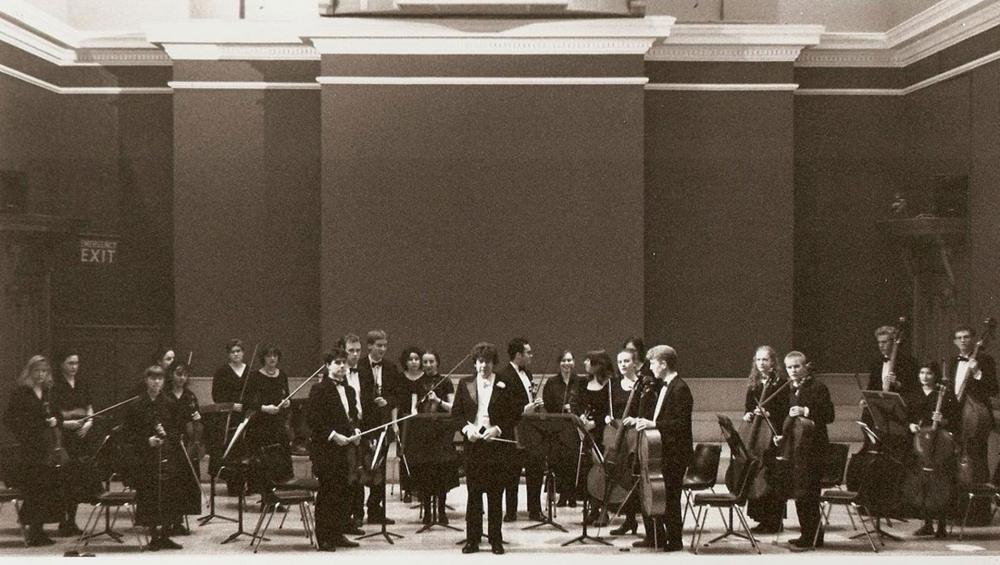
Emre spent nearly a decade at ECA studying his BMus (Hons) Music degree immediately followed by a PhD in Music. Whilst here, he founded the Edinburgh University String Orchestra which stills practices and performs to this day.
 
Since graduating, Emre has built a strong international career as a conductor, scholar and composer. He took an interest in “European Music at the Ottoman Court” and founded a professional ensemble dedicated to exploring this repertoire. Emre has conducted orchestras at several high-profile events including a concert during the 2004 NATO Summit. He continues to pursue scholarly research and compose professionally.

Why ECA?

Studying music for a BMus (Hons) degree at the University of Edinburgh began for me in 1990 at a time when the University still had a dedicated Faculty of Music, much like those at Oxford and Cambridge. This was before its reconstitution as the Reid School of Music within the Edinburgh College of Art in 2002. It was a different world then, in which the traditional academic ethos of earlier decades was still very much alive in the curriculum. The spirit of Sir Donald Francis Tovey—one of the great musical minds of the twentieth century, who had secured Edinburgh’s place on the academic map in the 1930s—still seemed to pervade the atmosphere.

As someone naturally inclined towards the past, I found myself deeply drawn to that tradition. But more than anything, it was the city of Edinburgh itself that beckoned: its architectural grandeur, its natural beauty, its air of romance. I come from Istanbul, and it was during a holiday in 1977, when I was just eight years old, that I first encountered the city—and fell in love with it. So, when the opportunity to study music there arose, I did not hesitate to embark upon the journey. The world, of course, has changed profoundly since then. Yet for me, the spirit of Edinburgh—timeless, austere, and quietly inspiring—remains undiminished. I must have enjoyed the University so much that I chose to stay on for a further four years to complete a PhD.  
"In my view, it was these distinctly Edinburgh experiences—rooted in music, friendship, beauty, and intellectual discovery—that proved most valuable to me, far beyond anything that can be measured in formal academic terms."

Emre Araci

Tell us about your time at ECA

My Edinburgh education shaped me profoundly. One of my early ambitions was to become an orchestral conductor, and in 1992 I gathered a group of fellow students to found the Edinburgh University String Orchestra—an ensemble which, gratifyingly, continues to flourish to this day. Conducting that student orchestra for nearly five years, often in the historic and atmospheric setting of the Reid Concert Hall, provided an invaluable foundation for the future. It was not simply a matter of developing a conducting technique; it also demanded skills in communication, organisation and diplomacy. During holiday periods, we arranged concert tours to the Highlands, performing in beautiful churches and romantic castles set amidst breathtaking scenery. These tours fostered deep friendships and created a remarkable sense of community among us. For me, it was all quite magical, and it undoubtedly helped shape both my love of nature and my broader outlook on life.

I also gained much through working with historical manuscripts and receiving instruction in archival research—whether dealing with old letters, diaries or musical scores—as I pursued my doctoral studies. My PhD focused on the life and works of the Turkish composer Ahmed Adnan Saygun (1907–1991). During the course of my research, I uncovered a series of letters from Sir Michael Tippett—one of the foremost British composers of the twentieth century—addressed to Saygun, revealing a long-forgotten friendship between the two men. Tippett was still alive at the time, and one of the most unforgettable experiences of my life was being invited to lunch with him at his home in Wiltshire. Similarly, meeting the celebrated Italian composer Gian Carlo Menotti over lunch at his then-residence—Yester House, a magnificent Adam mansion in East Lothian—left a deep and lasting impression on me. Menotti was a distinguished and profoundly romantic figure, and the encounter remains one of the great privileges of my student years. In my view, it was these distinctly Edinburgh experiences—rooted in music, friendship, beauty, and intellectual discovery—that proved most valuable to me, far beyond anything that can be measured in formal academic terms.

Tell us about your experiences since graduating

My career was established directly as a result of my education and musical activities at the University. In my final year, I was invited to conduct a concert during the official visit of the Turkish Ambassador to Edinburgh, leading the Edinburgh University String Orchestra in a programme comprising arrangements of nineteenth-century compositions in European dance forms, originally written by Ottoman sultans, members of the imperial family and resident Italian court musicians in Istanbul—among them Giuseppe Donizetti, the elder brother of the celebrated opera composer Gaetano Donizetti.

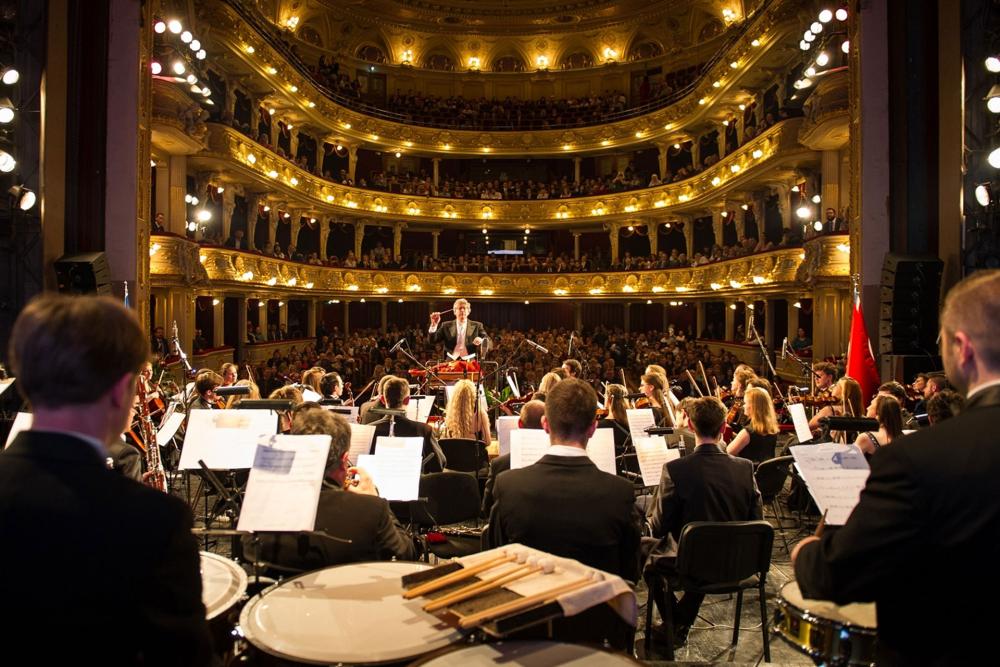
Following my move to Cambridge, this highly specialised area became something of a personal niche: “European Music at the Ottoman Court”. In time, I founded a professional ensemble dedicated to exploring this repertoire, and went on to conduct orchestras across the world—from Prague to Saint Petersburg, the Sao Carlos Opera House in Lisbon to Cadogan Hall in London. One particularly memorable engagement was conducting a concert at the Dolmabahçe Palace in Istanbul during the 2004 NATO Summit, in the presence of world leaders. I found myself, somewhat improbably, in conversation with Presidents George W. Bush and Jacques Chirac—an encounter that would be difficult to imagine in today’s altered geopolitical climate.

We recorded several albums devoted to this repertoire for major labels, including Warner Classics, and also presented the music through radio broadcasts. In 2012, I created a ballet entitled Murad V, based on the life of the eponymous sultan, who composed hundreds of pages of polkas, mazurkas and waltzes. The work was premiered in Ankara, in the presence of his descendants, who by then had become close friends. Alongside performance, I continued to pursue scholarly research, publishing several books, including a biography of Donizetti Pasha and a history of Istanbul’s long-vanished Italian opera house, the Naum Theatre. My creative endeavours also extended into composition, which I had begun during my student days. I have continued to compose professionally, most notably with a symphony entitled In Search of Lost Sounds. The piece evolved from an earlier one-movement composition written to mark the Golden Jubilee of Her Late Majesty Queen Elizabeth II—a commission from my friend Lady Lucinda Mackay, a distinguished artist, fellow Edinburgh graduate, and generous patron of the Edinburgh University String Orchestra. In every sense, then, Edinburgh provided me not only with inspiration, but with support and a firm foundation for the path I was to follow.

"My career was established directly as a result of my education and musical activities at the University."

Emre Araci

Alumni wisdom

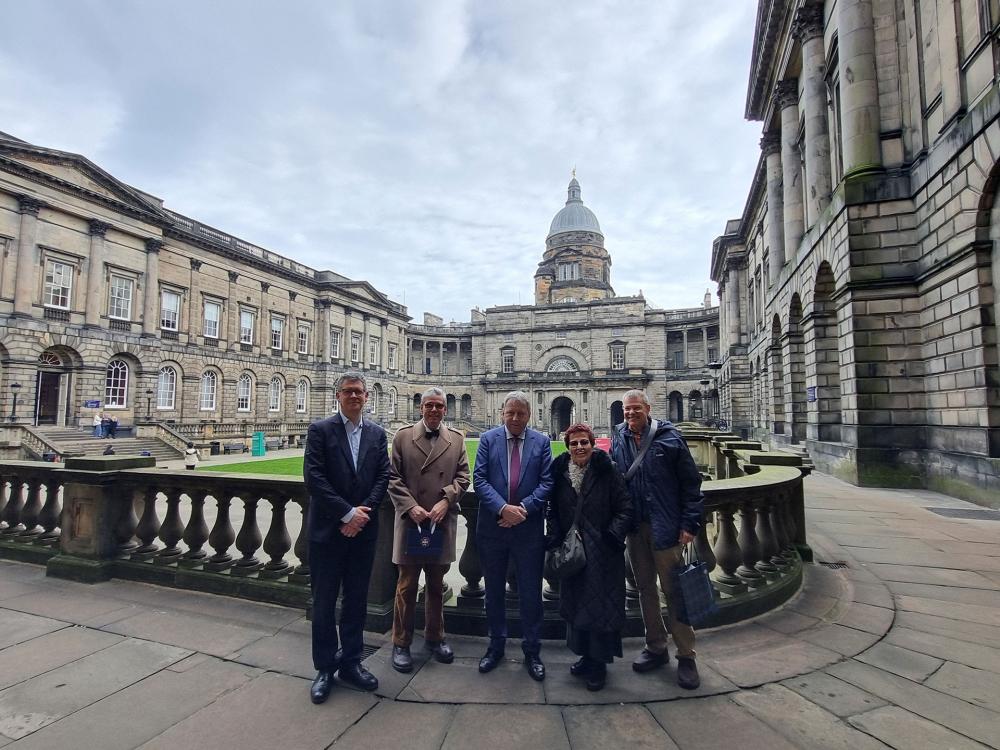
The world has, of late, become increasingly unrecognisable to me—and I suspect I am not alone in feeling this way. At such moments, one instinctively seeks to reconnect with the familiar, in search of comfort and consolation. It was under the influence of this sentiment that, in March 2025, my mother, my brother, and I returned to Edinburgh to revisit the scenes of my student days. For my brother, it was his first visit since 1977. There is no doubt that this was, for me, a time of soul-searching. Thanks to the kind efforts of the University’s Alumni Office, we were given a private tour of the McEwan Hall and the Playfair Library—places of deep and lasting significance in my education. Most unexpectedly, while in the quad of the Old College, we were met by the Principal and Vice-Chancellor, Sir Peter Mathieson, who presented me with a quaich bearing the University’s crest. It was a moment of quiet symbolism and friendship, and one that none of us shall forget. This homecoming was truly special. To those now entering the University, or preparing to graduate, I would offer this: take heart in knowing that Edinburgh—both the city and the University—will remain a source of strength and reassurance amid an ever-changing world. It has certainly been so for me. 

Associated programmes